Grab My Wrist

The reflections of a 47-year old beginner in Aikido, about training, learning, aiki, horsemanship, and life.

Linda Eskin is horse person (dressage/trails), user experience planner (Web/apps), and a student at Aikido of San Diego.

BROWSE POSTS BY SUBJECT

ADDITIONAL RESOURCES

Facebook

Linda Eskin is a fan of

Create your Fan Badge


A LITTLE ABOUT ME
Most of the posts here are duplicates of my posts from my blog on AikiWeb.com, a very active and friendly community of Aikido students and teachers. If you are a member of AikiWeb, and would like to comment, please do so there.

I am a beginning student of Aikido, a martial art that, like horsemanship, takes a lifetime to master. These posts are only my own observations on my own experience. You should not rely on anything I say here. Any inept or incorrect information is my own responsibility, and should not be a reflection on others.

I am grateful to Dave Goldberg Sensei for being an extraordinary teacher, and for creating an engaged, thinking, and compassionate community of students and teachers at Aikido of San Diego. If you are in the area, visitors are always welcome to observe classes. If you are a student at another local dojo, keep an eye on our dojo calendar for upcoming seminars and other events.

Copyright 2009, Linda Eskin. Please feel free to share any of my poetry, online, or in print, keeping my name and any other acknowledgments with it. I will almost certainly be happy to let you use anything else I've posted here, with proper attribution, but please ask first.

Contact me via e-mail


Linda Eskin


    follow me on Twitter


    MORE AIKIDO READING


    Questions for My Teacher's Teacher

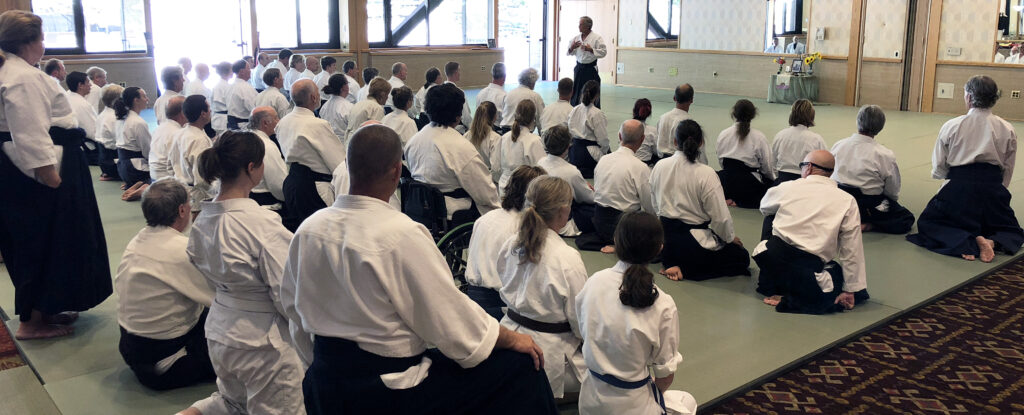
    My teacher’s teacher is coming to our dojo in April. My teacher, Dave Goldberg Sensei, is a student of Robert Nadeau Shihan. Nadeau Shihan will be leading a seminar at Aikido of San Diego, April 9-11, 2010.

    Nadeau Shihan, 7th Dan, trained in Japan with O Sensei in the 1960s. He has been teaching Aikido since 1965. He runs two dojo: Aikido of Mountain View, and City Aikido in San Francisco. His students have included several of my favorite Aikido authors: George Leonard, Wendy Palmer, and Richard Strozzi-Heckler Sensei. He is a founder and division head (Division 3) of the California Aikido Association. It is an honor to have him come to work with us.

    I had the privilege of training with Nadeau Shihan last year, before I’d even tested for 6th kyu, and very much enjoy and “get” his approach to teaching. I’m really looking forward to training with him again, now that I have a tiny bit more experience and perspective.

    This year, Friday evening will be a question and answer session. We’ve been invited to submit questions. I thought it might be interesting to share my questions here. If you want the answers, come to the seminar. Not that all, or any, of these will be asked, of course. Lots of people will be asking questions. This is just my unfiltered list - the things I wonder about.*

    Your Experience of Aikido

    Q: What brought you to Aikido?

    Q: Is there something in your background that made you particularly receptive to, or inquisitive about, what has been available for you in Aikido?

    Q: Did you find support and validation in Aikido for who you were already, or did Aikido change you?

    Q: Is there something you wish you’d discovered or realized earlier in your Aikido training that would’ve helped you grow or learn? Or something you actually did discover or realize, that fundamentally changed your approach or understanding?

    Or perhaps is there something you hope your students can grasp (or let go of), that would help them? Is there something you see your students struggling with, that you wish they could just *get* more easily?

    Q: Are there activities you find to be complementary to your Aikido practice? (Meditation, gardening, …) Would you recommend them to others, or does everyone have to find their own way?

    Q: In your experience of the larger “I” knowing who you are (such as why you love “junk,” or love movement), were those sudden realizations, that you immediately saw (“Aha!) to be true? Or did you go through a lot of seeking and questioning before you discovered what was so for you?

    Q: Do you continue to make discoveries about yourself through your practice of Aikido? How has that changed over time?

    Aiki

    Q: What kind of change of consciousness, or development of consciousness, is possible through Aikido? What might that look like, in people’s lives? In a community? In the world?

    Q: How does Aikido work? How much is mechanics, psychology, emotion, spiritual, energetic? Or do those characterizations even make sense in the context of Aikido?

    The Art of Aikido

    Q: If Aikido is a way of helping to bring peace and happiness to the world, what is the process by which you see that happening?

    Q: How has Aikido changed since you first came to it? Has it expanded and strengthened? Or lost focus, gone off the tracks, or become diluted?

    Q: What are your hopes for the future of Aikido, and how might that future come about?

    Teaching, Sensei, and Students

    Q: Do you see a correlation between the reasons people come to Aikido, and their likelihood to stay with the practice? Or maybe, does it matter why people walk through the door of the dojo, or just that they do?

    Q: What do you see as the best way to teach Aikido? Does the teacher convey knowledge directly, simply demonstrate, or support the student somehow in making discoveries on their own?

    Q: What do you see as a Sensei’s place in a student’s life? Instructor of practical skills? Role model? Spiritual guide? Counselor? Parental figure? Friend?

    Q: What do you hope your students (or students of Aikido in general) will get from practicing Aikido?

    Q: What do you hope your students (or students of Aikido in general) might contribute to Aikido?

    Your Experience of O Sensei

    Q: How would you characterize your relationship with O Sensei?

    Q: Did O Sensei make requests of you (and of others, if you know), like “Go back to the U.S. and teach this”? Was he teaching his students to teach, necessarily?

    Q: You have said that O Sensei had a process by which he could quickly jump into a bigger / higher level of himself. Could you tell us about the nature of that process? (Was it a physical practice? Meditation or prayer?)

    Q: Do you think that Aikido today is (or is becoming) what O Sensei envisioned for it? Is it growing and spreading as he’d hoped? Affecting humanity as he’d intended? Better / worse / different?

    Q: If you could spend an evening talking with O Sensei now, what would ask him? Or tell him?

    In thinking about these questions, it struck me that the world might be a much different place for many, many people, had a certain young Robert Nadeau not somehow connected with Aikido. Just another example of how one pebble can make waves affecting an entire ocean.

    *It occurred to me the day after posting these questions (and sending them off to Sensei) that I’d be interested in hearing others’ answers to them as well. If you teach Aikido, or have just practiced for a long time (however you define that), please feel free to copy some or all of my questions, and answer them on your own blog or Web site. I’d appreciate a mention, and please let me know where I can go to read your answers. Thanks!

    Elevator Speech: What is Aikido?

    Every so often someone will ask me “So, what’s this Aikido thing that you do?” They may have some idea that’s it’s “kind of like karate,” but they rarely know anything more. I usually end up stammering something about it being “a martial art, sort of like Tai Chi, but Japanese, and not really like Tai Chi, but there’s no punching and kicking. There’s this blending, and going with the energy, and… Oh heck, just come watch a class some time.” Pathetic.

    So I’ve been thinking that I should come up with an Aikido elevator speech, for just such occasions. An “elevator speech,” if you haven’t heard that term, is a very brief, clear statement, usually about what you do professionally, or what your company does. Something you can say when you talk to someone for a few seconds in an elevator.

    There are a few tricks to an elevator speech. Obviously, it has to be short. It has to be engaging, easy to understand, and memorable. Less obviously, but most important, it needs to evoke in the listener the correct understanding. That does not mean that your explanation needs to be complete, or even accurate. It means that you have to say something that causes the right picture to form in their mind, taking into account their experience, vocabulary, and state of mind. You might even need to consider their age, gender, cultural background, etc. You have to speak in a way that they get it.

    Let’s look at the answer to “So, what do you do?” from one of my past careers. I was “part owner, and operations manager, of an industrial equipment distributorship selling fueling system components to major oil companies and repair contractors. We sold leak detection systems, day tanks for emergency generators, bulk fueling systems for marine and aviation applications, and…” Well, you see, your eyes have glazed over already, haven’t they? You probably stopped paying attention at “operations manager,” or certainly by the time you got to “fueling system components.” And you almost certainly have no idea what a day tank is, unless you run a high rise or hospital. By trying to be complete and accurate (not to mention sounding all businessy and official), I have entirely failed at communicating what I did. I may also have left the listener feeling stupid for not understanding me.

    What I ultimately came up with, which worked very well, was “I run a warehouse that sells equipment for gas stations, y’know, like pumps, hoses, and nozzles, and really big underground tanks.” Now they have something they can relate to - things they can picture. They know what a warehouse is, and probably have some idea of what running one is about. They go to gas stations all the time. They have experience with gas pumps. They can easily imagine really big underground tanks, even though they may never have thought about them before. And I said it all in a very natural (for me) vocabulary so it didn’t sound like something invented at a company meeting about elevator speeches. Presto! In about 7 seconds they knew exactly what I did. They got it. They felt smart for understanding, and sometimes even were brave enough to ask a question or two.

    Incidentally, those big things you drive up to are really called “dispensers” - the “pumps” are down there with the underground tanks, where you never see them. But nobody knows or cares about that. We’re not trying to say accurate things, we’re trying to help the listener create an accurate picture. Just call them pumps. You can explain later, if they care.

    An elevator speech about Aikido, then, might need to address preconceptions the listener could have from watching action films, or knowing someone who did another martial art when they were a kid. It should avoid using Japanese. It might need to reassure someone who thinks you could be prone to violence, or encourage someone who’s thinking of trying it out themselves. And your words should help them imagine what Aikido might look like. Images are very memorable. Use color, size, numbers - anything to help them see it in their minds.

    Aikido is a martial art based on classical Japanese arts and Samurai traditions.

    In the first 5 seconds we’ve explained a lot, and with a little luck we’ve grabbed their attention and imagination. OK, it’s a martial art. That probably confirms what they were thinking already. A Japanese martial art. OK, cool. With roots in classical arts. Oh…? They may not know what classical Japanese martial arts are, but it sounds good - and it’s even accurate. (This is not the time to start explaining about daito ryu and O Sensei.) They’ve almost certainly heard of Samurai, and have some idea what they were about. They probably think that’s cool. And there’s something there about tradition. So far, so good.

    We wear white gis, and we all practice together on mats in a big dojo.

    This is a little bit of an easy break, after that intense first sentence. A mental resting place. They may not know the word “gi” but in the same breath we’ve told them it’s something white that we wear. They will probably have seen enough movies to know what we mean. (Yes, I know they are called gi, or dogi, with no “s”, but like the “gas pumps” we need to be understood right now. Worry about teaching them Japanese later.) Likewise, even if they don’t know the word dojo, we’ve told them it’s a big space with mats. They know what a high school gym looks like, so they can picture this, too. They may even feel a little smarter, because they’ve just understood us perfectly well, even though we used some unfamiliar words. And they know that we all practice together. Not only does it help paint the picture of the physical environment, there’s also a nice ring of community in it.

    We use weapons and empty-hand techniques to learn how to resolve conflict fluidly and effectively, instead of reacting out of fear or tension.

    Weapons are important in the practice of Aikido, but I’m mentioning them here for another reason: Knowing that we practice with weapons may help counter any “wimpy” impressions they may have about Aikido. We also have “effective” in there. If you are talking to someone who seems a little cautious about the whole “martial arts are scary” thing, just start with “We learn how to resolve conflict…” Without really needing to understand any details or philosophy of the practice, we’ve got “resolve conflict, fluidity, and effectiveness” overcoming “reaction, fear, and tension.” Who wouldn’t want that? And again, it’s accurate.

    That might be enough for them to absorb right now. We’ve explained a little, piqued their curiosity, and we haven’t overstayed our welcome. Here’s what we have:

    Aikido is a martial art based on classical Japanese arts and Samurai traditions. We wear white gis, and we all practice together on mats in a big dojo. We use weapons and empty-hand techniques to learn how to resolve conflict fluidly and effectively, instead of reacting out of fear or tension.

    Stop there, and see if they have any questions. Remember to keep answers very short and simple.

    You’ll want to come up with your own elevator speech, in your words. Just remember to follow the guidelines above. Speak so the listener understands. Give them what they need to paint the picture in their mind.

    If they are interested in knowing more, invite them to watch a class at your dojo! They’d likely be shy about coming, and afraid they’d be out of place or in the way, so let them know it’s a common occurrence, and that they’d be welcome:

    Come with me Friday night and watch a class. People do it all the time. We have chairs for visitors, and sometimes have two or three people checking it out. New students are even required to watch a class before they can join, so it wouldn’t be weird at all.

    I’d love to hear your Aikido elevator speech! If you’ve come up with a good, quick explanation, please share it in the blog comments on AikiWeb, on Facebook, or when I see you at the dojo!

    O Sensei is quoted, in The Art of Peace, as saying “No matter how heavily armed your opponent is, you can use the Art of Peace to disarm him (or her). When someone comes in anger, greet him with a smile. That is the highest kind of martial art.”

    This video shows so clearly how our actions, little things each of us do individually, can affect the world. A well-timed smile or hug can change someone just a little. They can affect those around them, and so on. Juan Mann, in the video, maybe affected a few thousand people directly. Over 10,000 signed his petition. Over 100,000 commented on the video on YouTube. Over 56 million people have watched just this version of it. 56 million!

    Much of what we do is like dropping a pebble in an ocean. We may never notice the affect of the waves we create, but we do create them. Practice peace.

    *sigh*

    Sunday at midnight…
    Aikido not ‘til Tuesday.
    Forty-two long hours.

    I'm Destroying Aikido.

    The comments on YouTube, about my 5th kyu exam, got off to a predictable start with “good luck in a street fight no offense” [sic].

    From looking at the person’s recent comments on other people’s videos, this is one of the nicest things they’ve said to anyone. Most of their other comments are downright vulgar.

    My reply: “None taken. In my 47 years I’ve never been in a street fight, and don’t intend to go around starting any scraps in pubs. :-) My practice of Aikido has nothing to do with fighting.”

    That apparently hit a nerve with someone in Poland, who said (ellipses his - I did not edit this): ”..and that this the reason this unique, interesting and demanding martial art is dying….cause people like You practice aikido with firm belief that it has nothing to do with fighting..sad…”

    I could just delete their comments, but what the heck, let’s see where this goes. I’m sure I won’t change their minds, but others coming along and reading the comments might find the discussion interesting. I responded:

    “Aikido is not dying, never mind being killed off by ‘people like me.’ Yes, it comes from centuries of fighting arts, and yes, it is effective. But O Sensei did not create it to help people become better street fighters.

    The goal of most non-sport martial arts is not fighting. It’s interesting that even in my video comments field you are trying to start one. If you want to fight, find others who want to fight, and have a great time. I’m not opposed to that, it’s just not what I’m up to.”

    I’m pretty sure that won’t be the end of it. There are a lot of people who are certain that becoming a better fighter is the primary, and only valid, purpose for practicing martial arts, and they typically try to promote that view through rudeness and bullying of anyone who practices the arts for any other reason. I wonder if fencing, kendo, tai chi, and archery catch the same kind of flak? Dressage actually does, on occasion, when people point out that a not-quite-perfectly-responsive horse could mean one’s death on the battlefield.

    I am no scholar on the subject of martial arts, but in my very limited experience I’ve not met any serious student or teacher who felt that fighting was the goal. Engaging in fights is never a desirable outcome. But if you must defend yourself or others, of course you should be able to.

    So far, I’ve mostly been able to. Perhaps it’s whatever confidence and presence I gained from a summer Judo class in 3rd grade, 6 months of Tang Soo Do in high school, or a very physical self-defense course in college. Maybe it was my practical, moral upbringing in a stable home. Could be a bit of street smarts from walking, biking, skateboarding, and taking the bus everywhere, and working a paper route for 3 years, as a girl, alone. Or knowing I can handle myself coordinating convoys of rigs rescuing livestock in the face of raging wildfires. I don’t go looking for danger or confrontation, but I don’t run, either. Attackers love weak, fearful targets. I’ve never been weak or fearful. I’ve been jumped and beaten once, by a predatory gang in junior high school, but I’ve never gotten into a fight, on the street or otherwise. I consider avoiding fights to be the bigger victory than being proficient in winning them.

    According to Kevin Blok Kyoshi (7th Dan in Yoshinkai Aikido), weak people cannot enforce peace. Blok Sensei teaches defensive tactics for police officers, and non-physical crisis intervention. He is an expert on the effective, practical application of Aikido. But even with that background (or maybe because of it) he speaks of Aikido as a path to peace and happiness. In his interview for the “Aikido - The Way of Harmony” podcast (which I highly recommend listening to), he speaks at length about bliss. He says that true budo is about love. (Listen especially starting at the 43 minute mark.) “You want to change the world, to make it a better place.” … “It starts with you. The center of your universe is you. Don’t go to try to make other people happy, and blissful, and loving, and caring, if you can’t do it with yourself.”

    George Ledyard Sensei put it plainly on his Web site, www.aikieast.com:

    Aikido
    It’s not about fighting.
    It’s about not fighting.

    Aikido takes a disproportionate amount of criticism, but the goals of promoting harmony and not fighting are not unique to Aikido.

    In high school I practiced Tang Soo Do - Moo Duk Kwan (a “hard” Korean art), for all of 6 months or so. I came to it to learn how to be violent, effectively. Instead I learned how not to be. Yes, there was sparring (which is great fun), and tournaments (including the requisite smashing of concrete blocks, demonstrated by the Master of our school), but it was made clear from the outset that we weren’t to be engaged in any fighting outside of class. Self control and good character were the goals. It was an art in the budo tradition, even if it included organized competitive fighting.

    I still have my notebook from 30 years ago. In it, along with several lists of Key Points, Principles, and Creeds, copied earnestly by hand from the sign on the dojang wall, is the Tang Soo Do Pledge:

    We pledge to contribute to the happiness of the human race with the sword and the pen, using any ability we possess in pursuit of justice for everyone, attempting to unite the perfect harmony and further the traditions of Tang Soo Do.

    I took it that pledge seriously then, and I still do.

    I learned decades ago to resolve conflict without physical violence, intimidation, or rude behavior. I came to Aikido for a lot of reasons, none of which were about becoming a better fighter, or even for self defense. I wanted to learn to relax and breathe, to have better balance, and to be able to stay focused and take effective action in the face of overwhelming physical threat. I am getting those things from my practice, but there is so much more available.

    I am learning there are a lot of kinds of “fighting.” Fighting what is. Fighting what I feel. Fighting who others are. Resisting. I still have a lot of fight in me. I’m not practicing Aikido to develop that, I’m practicing Aikido to let that go.

    There are many ways to travel one path.

    There are many ways to travel one path.

    - Tech Note: Improved Format -

    Hi Loyal Readers (all 8-10 of you)!

    Some of you have pointed out that the style sheet (CSS) for my blog was pushing the left navigation area off the screen in Firefox and Safari. I have finally gotten around to fixing it (I hope). I also expanded the content area of each post so the photos appear full size (500 pixels wide). I’ve tried it in IE8, Firefox, Chrome, and Safari on my iPhone, and it looks good so far. Please let me know if you see anything wacky.

    Many thanks for your patience, and for reading!
    Linda

    The other day in a weapons class Sensei wanted to work with bokken, and before class was considering what to focus on that day. The class ended up being an intensive little workshop, essentially, with lots of emphasis on breathing, correct technique, and incorporating weapons into familiar techniques, such as ikkyo.
Sensei’s classes are frequently, no, usually, like that.  ”Just a regular weeknight class” is never “just” anything.
After class I usually thank Sensei, if he’s not busy talking to someone. ”Thank you, Sensei,” I say, adding something like “I really enjoyed the class,” or “that was really interesting.” Even, maybe especially, when the class was challenging, or even frustrating.
It’s polite to thank your teacher, and sometimes I feel like it might come across as only that. Just being polite. But there’s nothing contrived about my gratitude. I deeply mean every word. (And I’ve told him so.)
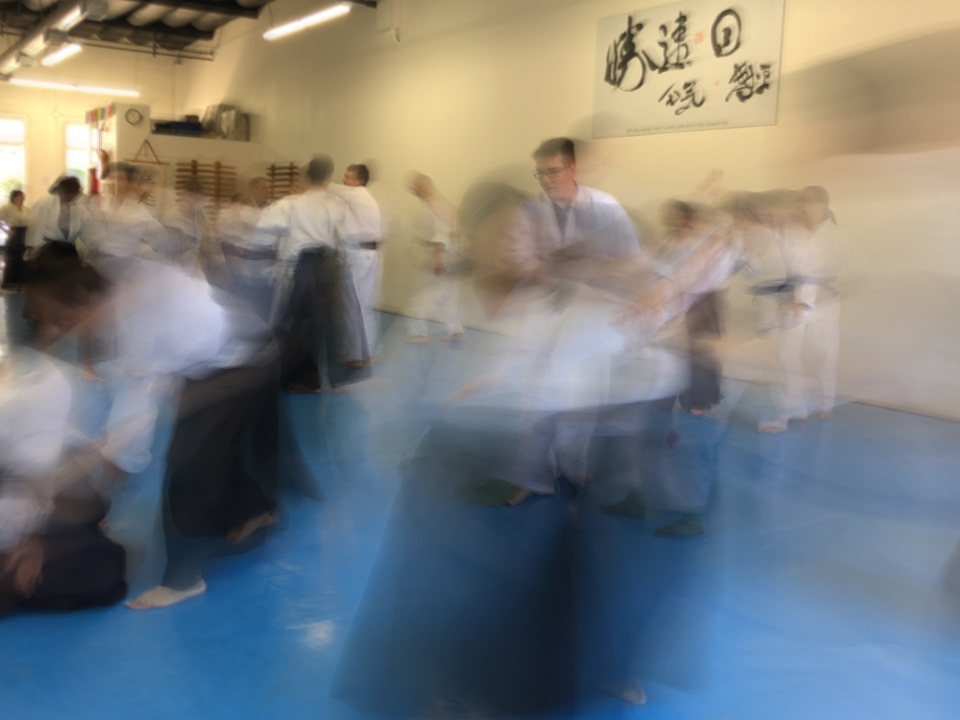
Classes are always inspired, never rote or perfunctory. Familiar techniques are presented in fresh ways, new subtleties explored. Sensei considers the response his words might elicit in a given student, knows just how much pressure or breathing room each person might need that day. He gauges the mood and abilities of the assembled students, and tailors the content of the class accordingly, on the spot. He sees endless detail in the mass of movement on the mat and offers strategic corrections, all while planning the next technique, managing the energy of the group, and keeping track of the time.
It all looks perfectly natural. For Sensei, it probably is. Just like it’s perfectly natural for a hawk to swoop at blinding speed through the branches of a tree, appearing on the other side with dinner in its talons. Perfectly natural from a lifetime of practice, and amazing to witness. It is as interesting to observe the teaching as it is to learn and practice the Aikido.
But as a student each class is a tremendous opportunity - to improve my Aikido of course, but also to examine my way of being, and to discover how I might take Aikido with me into the world. I am consistently blown away by the care and attention that goes into each class, and I am grateful for every opportunity to train under such a remarkable teacher.
Domo arigato gozaimashita, Sensei.
——-
A note from the next morning after I wrote the above post: 
I just went out to feed, and a hawk flew between the trees, at eye level, right in front of me, and across to the neighbor’s yard where it scattered a flock of small birds that were sitting in a tree.
I haven’t seen a hawk hunting in my yard in years.
There’s something really weird about the universe.

    The other day in a weapons class Sensei wanted to work with bokken, and before class was considering what to focus on that day. The class ended up being an intensive little workshop, essentially, with lots of emphasis on breathing, correct technique, and incorporating weapons into familiar techniques, such as ikkyo.

    Sensei’s classes are frequently, no, usually, like that.  ”Just a regular weeknight class” is never “just” anything.

    After class I usually thank Sensei, if he’s not busy talking to someone. ”Thank you, Sensei,” I say, adding something like “I really enjoyed the class,” or “that was really interesting.” Even, maybe especially, when the class was challenging, or even frustrating.

    It’s polite to thank your teacher, and sometimes I feel like it might come across as only that. Just being polite. But there’s nothing contrived about my gratitude. I deeply mean every word. (And I’ve told him so.)

    Classes are always inspired, never rote or perfunctory. Familiar techniques are presented in fresh ways, new subtleties explored. Sensei considers the response his words might elicit in a given student, knows just how much pressure or breathing room each person might need that day. He gauges the mood and abilities of the assembled students, and tailors the content of the class accordingly, on the spot. He sees endless detail in the mass of movement on the mat and offers strategic corrections, all while planning the next technique, managing the energy of the group, and keeping track of the time.

    It all looks perfectly natural. For Sensei, it probably is. Just like it’s perfectly natural for a hawk to swoop at blinding speed through the branches of a tree, appearing on the other side with dinner in its talons. Perfectly natural from a lifetime of practice, and amazing to witness. It is as interesting to observe the teaching as it is to learn and practice the Aikido.

    But as a student each class is a tremendous opportunity - to improve my Aikido of course, but also to examine my way of being, and to discover how I might take Aikido with me into the world. I am consistently blown away by the care and attention that goes into each class, and I am grateful for every opportunity to train under such a remarkable teacher.

    Domo arigato gozaimashita, Sensei.

    ——-

    A note from the next morning after I wrote the above post:

    I just went out to feed, and a hawk flew between the trees, at eye level, right in front of me, and across to the neighbor’s yard where it scattered a flock of small birds that were sitting in a tree.

    I haven’t seen a hawk hunting in my yard in years.

    There’s something really weird about the universe.